How do you know if the lens you are using is good?
If you are familiar with industrial image processing applications, you can quickly get started using an existing system. If this is your first experience in this field, you can get basic information with a short research. Elements such as camera resolution, system processor capacity, and light sources are concepts you frequently encounter in daily life, so it is easier to master them. However, lens selection can be a little more complicated. Choosing the right lens is one of the most critical stages of a successful image processing application.
So, what criteria do you need to look at to decide which of the 2 lenses is better? Our first suggestion is that the more expensive one is usually better. Of course, we do not recommend this. Because you may be faced with a price approach prepared with the "Chivas Regal effect" in mind.
Let's look at the lens specifications first.
Criterion Determining Quality in Industrial Lenses: MTF (Modulation Transfer Function)
There are various criteria to understand the quality of lenses used in industrial applications. One of these is "MTF", that is, Modulation Transfer Function. It may sound a little technical, but calm down! We will soon make this something you can understand while sipping your tea.
What is MTF?
MTF is a measure of how clearly and contrastly a lens can convey an image. In simpler terms, it describes how well the lens can display details. So, "Are the details still there, or are they lost in blur?" is the answer to the question.
Choosing the right LED lighting can be a challenge for industrial image processing beginners and even those with some experience. The challenges we face may be related to the environment, working distance, limited space or even an unusual product.

Why is MTF important?
1. Detail and Sharpness: High MTF values indicate that the lens can clearly convey fine details.
2. Contrast: Higher contrast makes the image more distinct. So, good news for those who want to see black as black and white as white!
3. Area of Lens: MTF helps us understand how the lens performs at the center and at the edges. A quality lens provides consistent performance throughout the field.
The higher the quality of the lens, the more perfectly it refracts light, and the less black and white mix together.
So How Is MTF Measured?
MTF is expressed in “lp/mm”, the higher this value is, the sharper images the lens can deliver.
Standard test cards consisting of evenly spaced black and white lines (for example, the 1951 USAF target or Ronchi pattern) are ideal for testing system performance.
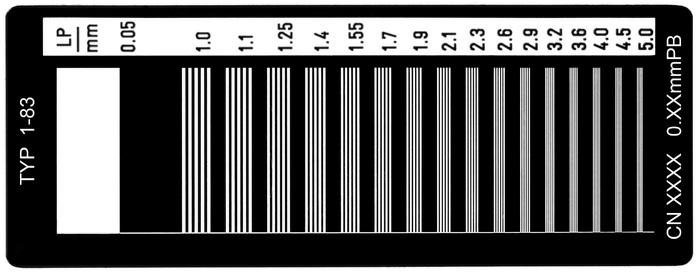
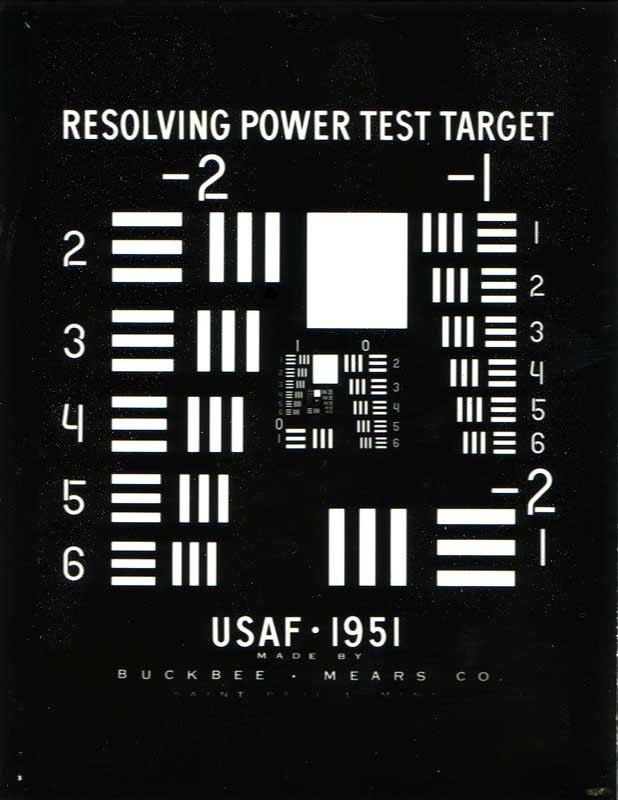
The proximity of these black and white lines is usually expressed in terms of line-pairs per millimeter (lp/mm) (where a line pair refers to a sequence of one black line and one white line). The measure of millimeters per pair of lines is called the spatial frequency for the object we are viewing. The inverse of the spatial frequency gives the distance in millimeters between two resolved lines. For example, a continuous series of pairs of black and white lines with a spatial period of 1 micron per pair repeats 1000 times per millimeter and therefore has a spatial frequency corresponding to 1000 lines per millimeter.
Bar patterns in the tangential (T) and radial (R) directions defined according to the lens center present different MTF values. In a tangential target, the lines are placed tangential to the image circle, whereas in a radial target, the lines are perpendicular to the image circle. The closer the tangential and sagittal curves are, the better the imaging performance of the lens.
After the standard MTF test, the values for sharpness, contrast and homogeneity of the lens are reached and MTF graphs are created.
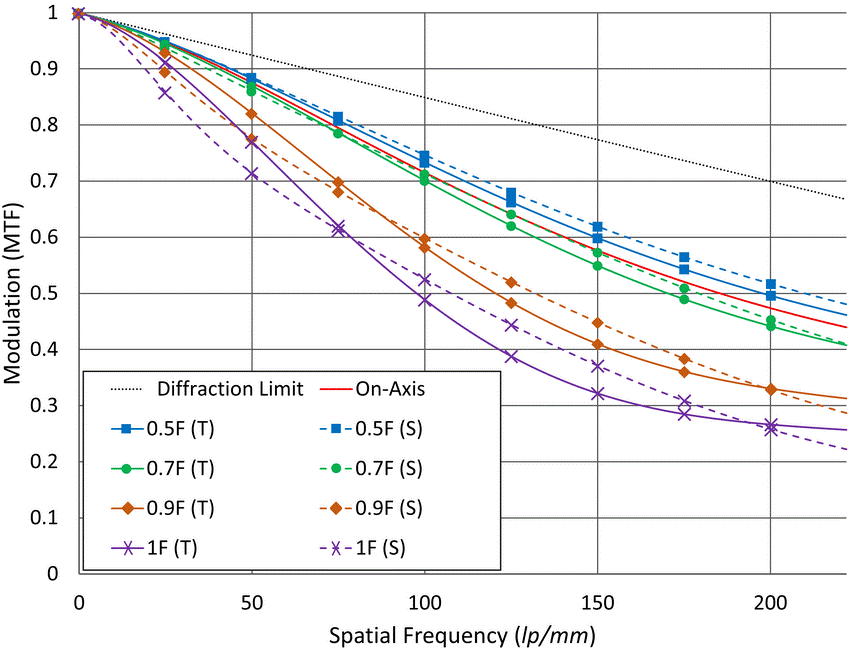
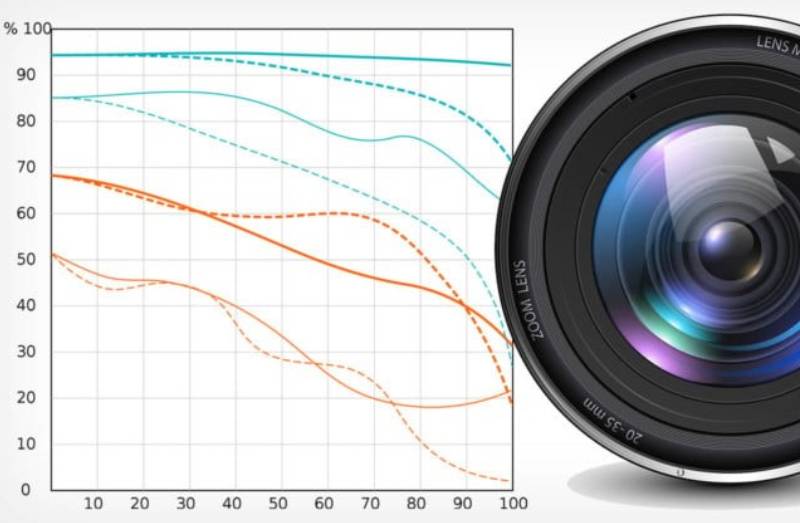
MTF charts are used to see the performance of the lens. If you are not a professional at image processing, it may be difficult to understand.
In these charts:
• horizontal axis, Shows the level of detail.
• vertical axis, Specifies the percentage of contrast transfer.
In principle the following applies:
• The higher the modulation curves, the better the lens
• The closer the tangential and sagittal curves are, the better the imaging performance
• If modulation drops below 20% in an area, the optic is probably not suitable for inspection in that area.
For such matters, always consider the advice and knowledge of trusted experts. Many important details cannot be obtained by looking at data sheets alone and in-depth product knowledge is required to determine the most suitable solution. Therefore, it is important to make your own assessments for an ideal analysis.
Even though high-quality optics and cameras are used, there are a few tips to pay attention to in order to make sharp measurements, that is, higher MTF.
1- Closing the Aperture
As we mentioned in our previous blog, a smaller aperture provides a larger sharpness area and higher MTF, and narrowing the aperture is something to be considered when it is necessary to make sharper measurements.
2- Using the optical center
Imaging performance deteriorates significantly from the optical center to the image border. For optimum performance, be sure to check the application MTF when setting up your system and adjust your image position to point your precise controls to the optical center as much as possible.
3- Increasing Focal Distance
Since lenses with larger focal lengths look farther with a narrower angle of view, they receive the rays more parallel, and this reduces the effect of distortions that occur as they move away from the optical center.
Use of MTF in Industrial Applications
Industrial lenses are frequently used in automation and quality control systems. MTF is a guide to understanding the success of these lenses.
• Error Detection: Lenses with high MTF values are preferred to detect defects faster and more precisely.
• Homogeneous Performance: It is important that the lens provides consistent performance from the center to the edges, especially in applications requiring wide-field vision.
MTF is an important criterion in measuring the imaging quality of the lens. High MTF values provide clear and detailed images. In industrial applications, MTF graphics should be taken into account to select a quality lens.
Finally, think of MTF charts like a puzzle. Once you find the right lens, your vision will be in "full clarity"!