Communication from Cloud to Field with IO-Link
The Smart Factory dream, which includes real-time two-way communication across field-level devices, is now more realizable than ever before. This is partly thanks to the IO-Link digital protocol. Now sensors and actuators communicate about more than just simple On/Off signals or analog outputs.
These components can now communicate with the controller about its performance, providing advanced status and identification information. Moreover, it reaches the ultimate in flexible production by changing the parameters of the sensor. IO-Link also enables Industry 4.0 by offering connectivity at the sensor level.
If we take a look at the advantages;
- Real-time data collection from the field level, paving the way to IoT
- Move this data upstream for instant “Big Data” analysis
- Mass customization and rapid production changes
- Maximum uptime with condition monitoring and predictive maintenance
- Intensive machine collaboration
- Fast design and installation
IO-Link ; A communication technology that reaches the sensor level
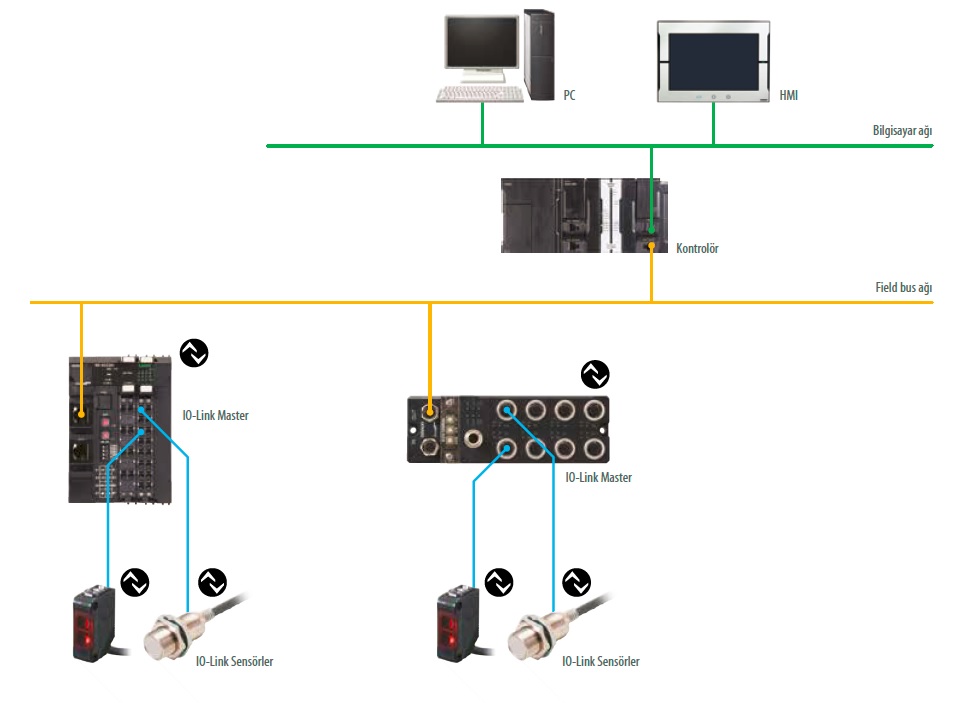
IO-Link is a standardized point-to-point communication protocol that allows sensors and actuators to exchange data with the controller. Bidirectional communication is established so that parameters can be transferred from the controller to the devices and the status can be read. Since December 2015, more than 100 companies, including major sensor manufacturers, have joined the IO-Link Consortium.
IO-Link allows not only typical sensor and actuator signals but also the setting of parameters and device status information. This communication is carried out in a bidirectional manner. In the IO-Link specification it is possible to various data flow speeds and to be compatible with COM2 and COM3.
You can connect an IO-Link Sensor and both IO-Link and standard devices with a single IO-Link Master. The master can manage both operating modes simultaneously.
Preventive maintenance monitoring prevents unexpected line outages
With IO-Link, field devices are monitored and corrected before they fail and cause a line outage. For example, if dirt accumulates on the lens of a photoelectric sensor, it can alert the operator to clean it by sounding an alarm via IO-Link before the sensor stops working. Another example of this is identifying excessive proximity control causing inductive sensors to collide.
By constantly monitoring each of the sensors, corrective actions can be taken before the device malfunctions. Corrective actions can also be planned during quiet periods to minimize the impact on productivity.
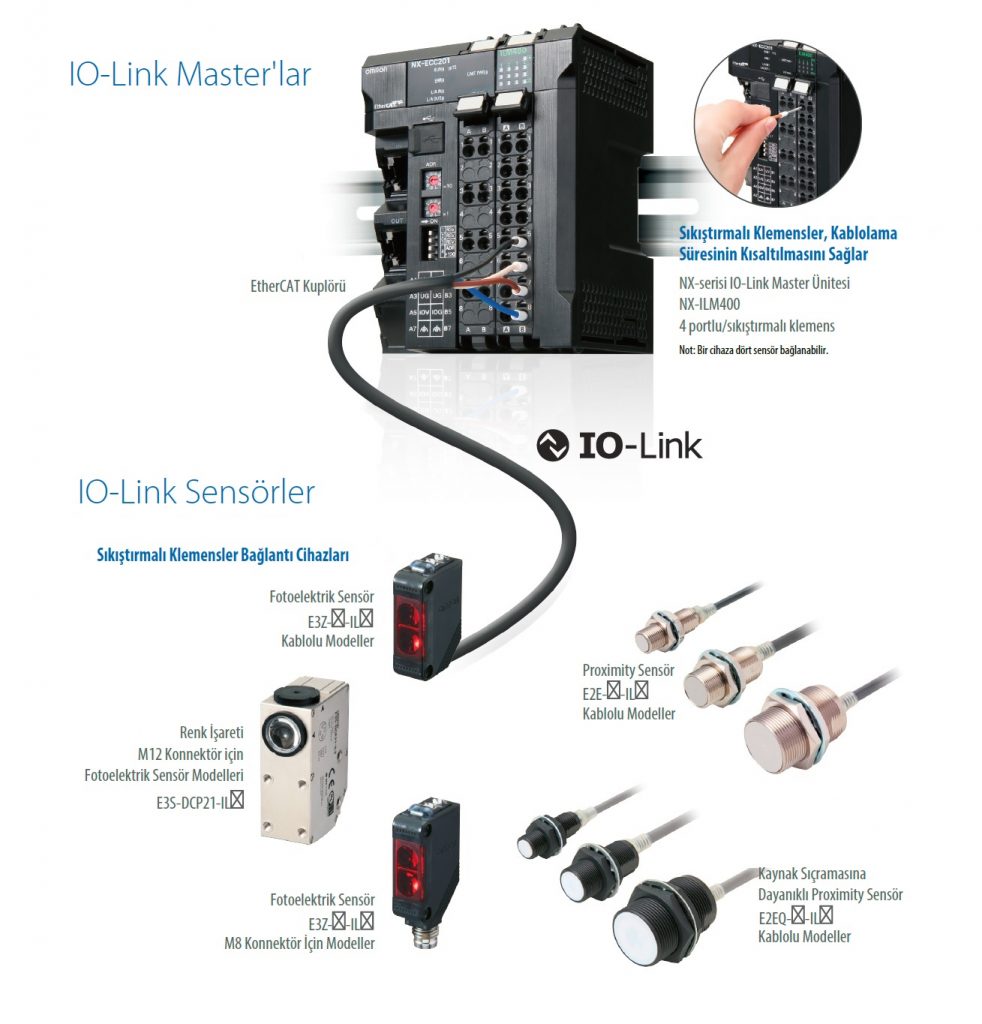
Fast and automatic product changeover
With traditional sensors and actuators, changing the format of production (switching from product A to product B) requires manual adjustments. This process takes time and errors may occur. However, with IO-Link, new format settings are automatically and error-free transferred from the controller to all sensors and actuators. And this…
- Error-free installation
- Minimum replacement time
- higher efficiency
- Means more flexibility
This results in on-demand production, which helps reduce inventories and their associated costs.
Simplifying engineering
IO-Link enables sensor and actuator parameters to be downloaded from the controller, avoiding manual configuration when building a machine or replacing a component. There is also a device identification check that warns if the wrong device type is installed.
By monitoring all field devices, the root of the problem can be easily located and machine downtime is reduced by eliminating the time required to investigate and fix the problem.
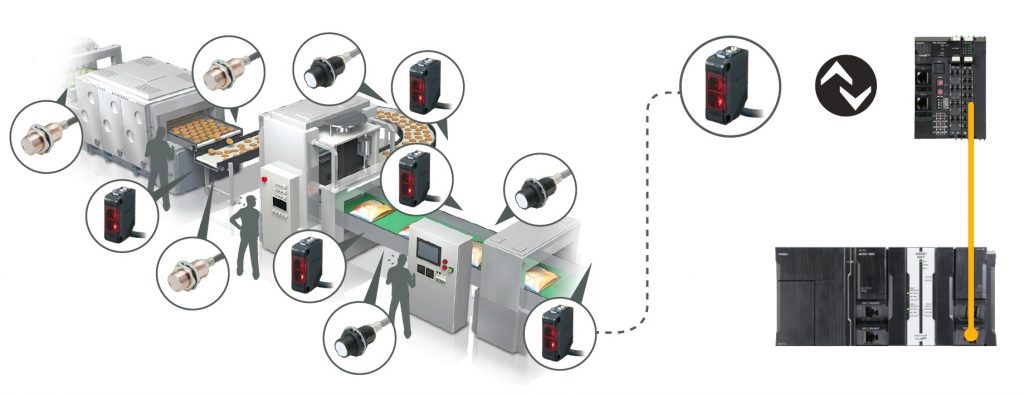
Easily troubleshoot machine problems
With IO-Link, commissioning time is reduced and configuration errors are minimized; because the controller checks the accuracy of each sensor and then downloads the parameters. Therefore, there is never a wrong sensor and there is no need to manually configure sensors one by one. Additionally, any wiring errors can be identified before the machine is powered on.
During production, the controller constantly monitors all devices and instantly identifies problems so they can be resolved before they become emergencies. Additionally, during a rare event such as a line outage, IO-Link provides instant advanced diagnostics so there is no need to spend time investigating the cause.
remote connection
Thanks to IO-Link communication, remote technical assistance can reach the sensor and actuator level. This simplifies troubleshooting the machine as it can be connected to all devices without the need for expert assistance to be on site. Therefore, since problems can be resolved remotely, machine downtime can be shortened without the need for qualified operators at the production facility.