Accuracy? Reproducibility?
Is it success if a shot goes to the center? What about hitting the same spot every time?
The real mastery is being able to reach the truth again and again.
When users need to use a measuring device, most want to know the accuracy and repeatability of that device… with an emphasis on accuracy.
However, terminology can be confusing at times. The two most common terms are accuracy and repeatability and are often used interchangeably. When someone says a measuring device is very accurate, they may actually mean that it is repeatable. In fact, there is no relationship between accuracy and repeatability. When a system makes many repeated measurements, it may not actually give very accurate results, or vice versa.
What is accuracy?
Here's a simple definition: accuracy is the ability of a measuring device to achieve the true position.


Accuracy often depends on many factors other than the measuring device itself.
In real-life production, many factors can affect accuracy. The practitioner needs to understand how environmental variables and components can affect accuracy. For example, color change, vibration, changes in material, etc.
What is repeatability?
Simply put, repeatability is the ability of a measuring device to achieve a specific position over time.

In short, the example below may be more descriptive.
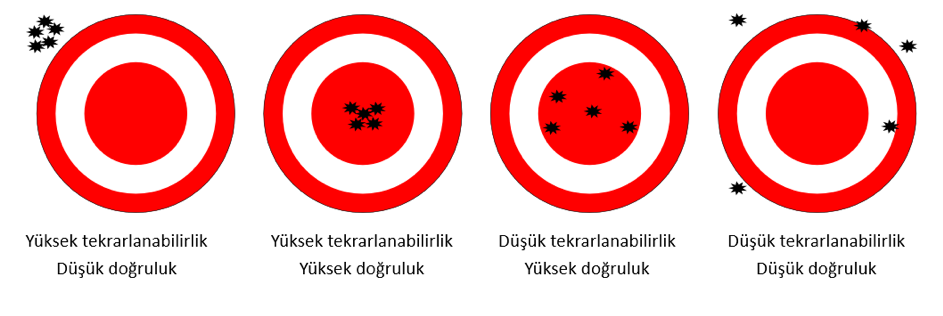
All requirements of the application need to be measured to know whether accuracy is required or repeatability and suitability of the job to be done. Because accuracy can be expensive. Repeatability is more budget friendly.
With our expertise in in-line measurements, we can support you with the most suitable measurement products.